
Why Balance Changes with Parkinson’s (And What You Can Do)

Living with Parkinson's involves a lot of adjustments. Some days feel manageable. Other days, even standing up from a chair or walking across a room feels like more effort than it should. And if you or someone you care about has noticed more stumbling, hesitation when turning, or a feeling of being "off," you're not imagining it.
Balance problems are one of the most common and most frustrating parts of Parkinson's disease. They don't just affect how you move. They affect how confident you feel leaving the house, whether you feel safe in the kitchen, and how much you can do on your own each day.
But here's what's important to know: balance changes with Parkinson's are not random. There are real, specific reasons why they happen. And once you understand the "why," the path toward doing something about it becomes a lot clearer.
Let's start from the beginning.
Why Parkinson's Causes Balance Problems
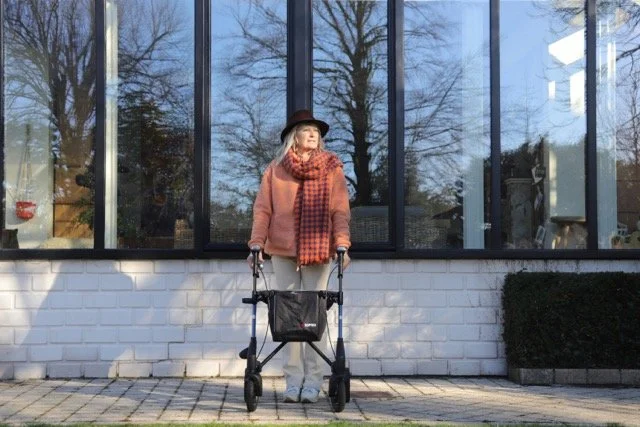
To understand why balance becomes an issue, it helps to know a little about how Parkinson's affects the brain and body.
Parkinson's disease affects the part of the brain that produces dopamine, a chemical messenger that helps coordinate smooth, controlled movement. When dopamine levels drop, the brain has a harder time sending clear signals to the muscles. Movements become slower, smaller, and less automatic.
Now here's where balance comes in.
Staying upright isn't just about your legs or your core. Your body relies on a constant loop of information: your eyes tracking your surroundings, your inner ear sensing your position, and your muscles and joints sending feedback about where you are in space. Your brain takes all of that input and makes tiny, rapid adjustments to keep you steady.
With Parkinson's, that loop gets disrupted. The brain processes balance signals more slowly. The automatic corrections your body used to make without thinking now require more effort and concentration. At the same time, the muscles may not respond as quickly as they need to when a shift in weight or an unexpected surface demands a reaction.
This is what clinicians call postural instability, and it is one of the hallmark features of Parkinson's disease. It tends to develop gradually, often becoming more noticeable in the middle to later stages of the condition. But even in earlier stages, subtle changes in posture and stability can already be present.
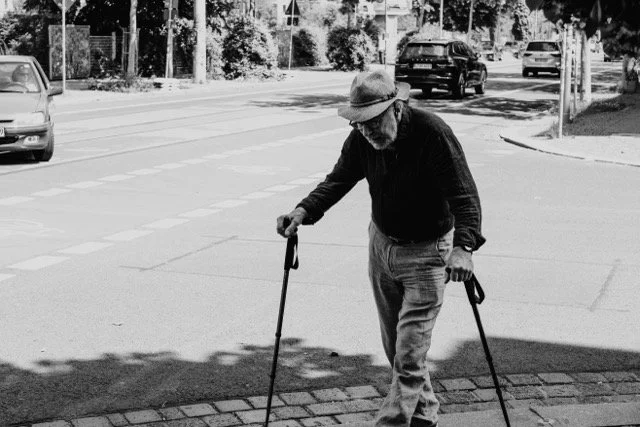
There's also another piece to this puzzle: posture itself. Many people with Parkinson's develop a forward-leaning posture over time, where the head and shoulders drift forward and the trunk rounds slightly. This shifts your center of gravity, making balance harder to maintain. When you're already leaning forward, your margin for error becomes smaller. A gentle bump, an uneven step, or even just reaching for something can tip the balance beyond what your body can correct.
Understanding these changes is the first step. The next step is recognizing what they look like in daily life.
What Balance Impairment Looks Like in Daily Life
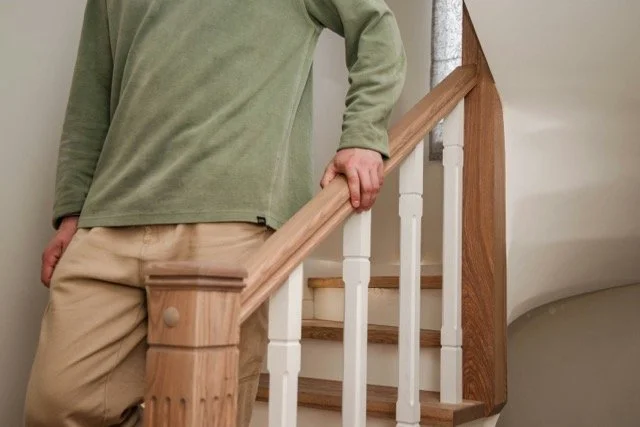
Balance issues in Parkinson's disease don't always look dramatic. In fact, many people don't realize how much their balance has changed until a close call happens or someone points out patterns they hadn't noticed.
Here are some of the most common signs that balance is being affected:
Freezing of gait, especially when approaching a doorway, turning, or starting to walk
Shuffling steps that are shorter and closer to the ground, leaving less room for error
Difficulty turning without losing stability, often described as feeling like the feet are glued to the floor
Unsteadiness when reaching, bending, or looking up or to the side
Trouble on uneven surfaces like grass, gravel, or slightly sloped driveways
Hesitation on stairs or reluctance to step over curbs
A tendency to lean or drift to one side without realizing it
Reduced arm swing, which plays a bigger role in balance than most people expect
Difficulty recovering from a stumble, because the automatic response to catch yourself has slowed down
Increased anxiety about falling, which itself leads to more guarded, restricted movement
That last point is worth pausing on. Fear of falling is real, and it has real consequences. When someone starts avoiding movement out of concern for their safety, they become less active. And less activity leads to weaker muscles, reduced coordination, and, over time, even greater difficulty with balance. It becomes a cycle that's hard to break without deliberate, focused effort.
These signs are not just inconveniences. They are signals that the body needs targeted support, and the sooner that support begins, the better the outcomes tend to be.
Now that we've looked at what's happening and how it shows up, let's talk about what you can actually do.
What You Can Do About Parkinson's Balance Problems
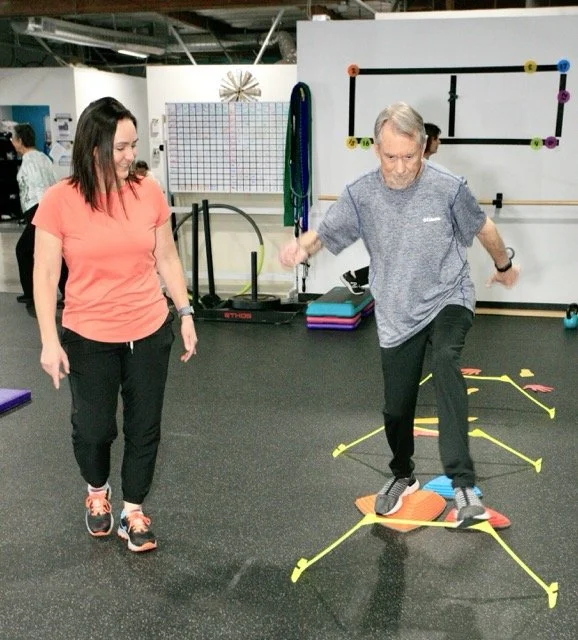
The good news is that balance is trainable. Even with Parkinson's, the brain retains a degree of plasticity, meaning it can adapt and learn with the right input. This doesn't mean Parkinson's can be reversed, but it does mean that consistent, specific training can make a real difference in how steady and confident you feel.
Here's where to start.
1. Focus on Big, Intentional Movements
One of the defining features of Parkinson's movement is that everything gets smaller over time. Steps get shorter. Arm swings shrink. Posture collapses inward. The brain stops sending the signal that "big" is normal.
Amplitude-based training works against this by deliberately practicing movements that are larger than what feels natural. Over time, this retrains the brain's sense of what normal movement feels like, so that bigger movements become easier and more automatic. For balance specifically, larger steps give your feet more room to stabilize. Better posture brings your center of gravity back where it belongs.
One well-known framework that applies this principle is PWR! Moves, a Parkinson's-specific exercise approach developed by physical therapists. It focuses on four fundamental movement patterns: getting up from the floor, shifting weight, stepping, and reaching. These aren't just exercises. They are the building blocks of the movements people with Parkinson's need most in daily life, and they are built around the idea that bigger, more intentional movement is what the brain needs to stay calibrated. Incorporating PWR! Moves into a routine gives your body a structured way to practice the very movements that balance depends on.
2. Work on Weight Shifting
Good balance depends on your ability to shift your weight in a controlled way, forward, backward, and side to side, without losing stability. Many people with Parkinson's become hesitant to shift their weight fully because it feels risky.
Practicing weight-shifting exercises in a safe environment builds the muscle memory and confidence your body needs. This might look like gentle side steps, reaching exercises while standing, or stepping onto and off of a slightly raised surface.
3. Practice Dual-Task Activities
In real life, you rarely just walk. You walk while talking, while carrying something, or while looking around. Parkinson's makes dual-tasking more difficult because the brain is already working harder to manage movement.
Practicing dual-task activities, like walking while answering questions or stepping while tracking an object with your eyes, helps your brain get better at managing both tasks at once. This directly reduces fall risk in everyday situations.
4. Strengthen the Core and Lower Body
The muscles around your hips, thighs, and core are your balance foundation. When they're weak, even a small disruption can throw you off. Targeted strength work for the legs and trunk gives your body the physical tools it needs to maintain and recover stability.
This doesn't require heavy weights or complicated equipment. Seated exercises, standing exercises with support, and body-weight movements all count.
5. Address Posture Directly
Stretching and mobility work for the chest, shoulders, and spine can help counteract the forward lean that develops with Parkinson's. Even small improvements in posture can significantly improve your balance margin.
6. Move Consistently
This one matters more than most people realize. Balance is a skill, and skills erode without practice. Training two or three times a week is helpful, but training four to five times a week is where real and lasting improvement tends to happen. The nervous system responds to repetition. The more often you practice balance-related movements, the more automatic those corrections become.
These principles work. But applying them on your own can be difficult, especially when symptoms fluctuate, and it's hard to know where to start. That's where working with a program designed specifically for Parkinson's makes a big difference.
How Rogue Physical Therapy & Wellness Supports Balance With Parkinson's
In-Person Training at Rogue Physical Therapy & Wellness
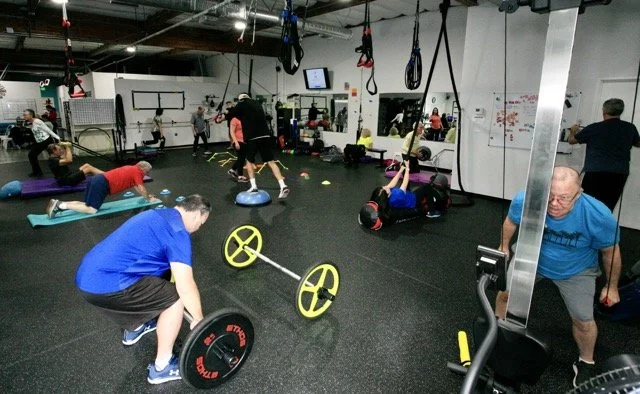
At Rogue Physical Therapy & Wellness, we work specifically with people living with Parkinson's. Balance training is not a side note in what we do. It is central to it.
We offer two ways to access balance-focused Parkinson's support, depending on what works best for your life.
Our in-person program in Orange County gives you direct access to neurologic physical therapists who specialize in Parkinson's care. Sessions are structured to address the specific movement challenges that come with the condition, including balance, gait, posture, and strength.
Training in person means you get real-time guidance and corrections during your session. You're not guessing whether you're doing an exercise correctly. You're being coached through it, which matters a lot when balance and fall risk are the concern.
Members train alongside others who are working through similar challenges. That community element is something people often say makes it easier to stay consistent, and consistency is the foundation of everything.
The in-person environment also allows your therapist to monitor changes in your balance over time and adjust your program as needed. Parkinson's is not a static condition. Your program shouldn't be either.
Beyond what happens in the session itself, many members say the biggest benefit is the confidence that carries over into daily life. When you've practiced recovering from a stumble in a safe space, you feel less afraid of it happening outside.
Online Training Through Rogue in Motion
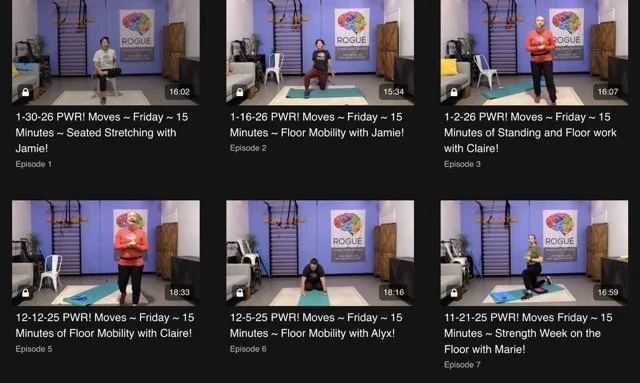
If you're not located near Orange County or prefer to train at home, our Rogue in Motion online membership brings the same Parkinson's-specific approach directly to you.
Through Rogue in Motion, you get access to live Zoom classes five days a week, plus a library of on-demand videos that includes balance, strength, gait, cardio, and more. Classes are led by physical therapists who understand how Parkinson's affects movement and who build sessions around what people with the condition actually need.
The flexibility of online training means you can work within your schedule and your best medication window. You also have access to interactive Q&A sessions where you can ask questions about what you're experiencing and get guidance specific to your situation.
For people who feel uncertain about whether they're doing the right exercises for their balance, having that kind of expert access is reassuring. You're not just following a generic workout. You're following a program built around the realities of Parkinson's.
Both paths, in-person and online, are part of the same mission: to give people with Parkinson's the targeted balance support for Parkinson's they need to move through daily life with more confidence and less fear.
Final Thoughts: Balance Changes, But So Can Your Response to It

Parkinson's balance problems are real, they are specific, and they are worth taking seriously. But they are not something you simply have to accept without a response.
Understanding why balance changes with Parkinson's, whether it's the slowdown in dopamine signaling, the disruption of postural reflexes, or the gradual shift in posture, gives you a foundation for doing something about it. And doing something about it, consistently and with the right guidance, is where real improvement happens.
You don't need to wait for a fall to take balance seriously. Small changes in how you move are already telling you something. The earlier you act on those signals, the more options you have.
Whether you're just starting to notice balance changes or have been managing postural instability for a while, there is a path forward. If you're ready to take a closer look at where you stand and what kind of support fits your situation, explore your options for support for balance and stability with Parkinson's with Rogue Physical Therapy & Wellness.
You don't have to figure this out alone, and you don't have to wait until things get harder.