
PWR! Moves for Parkinson’s: The Basic 4 Exercises
PWR !Moves is a Parkinson’s-specific exercise approach designed to help people practice bigger, more purposeful movements. Developed by physical therapist Becky Farley, PhD, the program centers around four foundational movements—PWR! Up, PWR! Rock, PWR! Twist and PWR! Step—that target movement skills commonly affected by Parkinson’s.
These exercises can be adapted to different ability levels and practiced in a variety of positions, including sitting, standing, lying down and all fours. They can also be incorporated into everyday activities, rehabilitation and group exercise. PWR4Life
Whether you’re newly diagnosed, looking for Parkinson’s-specific exercises or simply want to understand what PWR!Moves is all about, here’s where to start.

PWR! Moves at a Glance
The four foundational PWR! Moves each focus on a different movement skill:

Together, the Basic 4 provide a foundation that can be incorporated into exercise, everyday movement and activities that matter to you. The official PWR! approach describes these movements as building blocks that can be integrated into exercise programs, daily activities, recreation and rehabilitation.
What Are PWR! Moves?
PWR! Moves were developed specifically for people with Parkinson’s.
Parkinson’s can affect the size, speed and coordination of movement. You may notice smaller steps, reduced arm swing, stiffness, difficulty turning or a more flexed posture. PWR! Moves gives you a structured way to practice movements with greater effort and amplitude.
Rather than focusing only on isolated exercises, the goal is to carry those movement strategies into real-life activities - getting out of a chair, turning, reaching, walking, getting in and out of bed and moving more confidently through your day.
One of the biggest advantages of PWR!Moves is adaptability. The same foundational movement concepts can be adjusted based on your abilities, goals and current level of mobility.
The Basic 4 PWR! Moves
You don’t have to wait to experience the benefits of PWR! Moves. Here are four foundational exercises you can do at home.
PWR! Up

Purpose: Strengthens posture and counters stooping.
How-To: Stand tall, with your feet shoulder-width apart. Reach both arms overhead, stretching as if you’re trying to touch the sky. Hold for 5 seconds, then release.

2. PWR! Rock
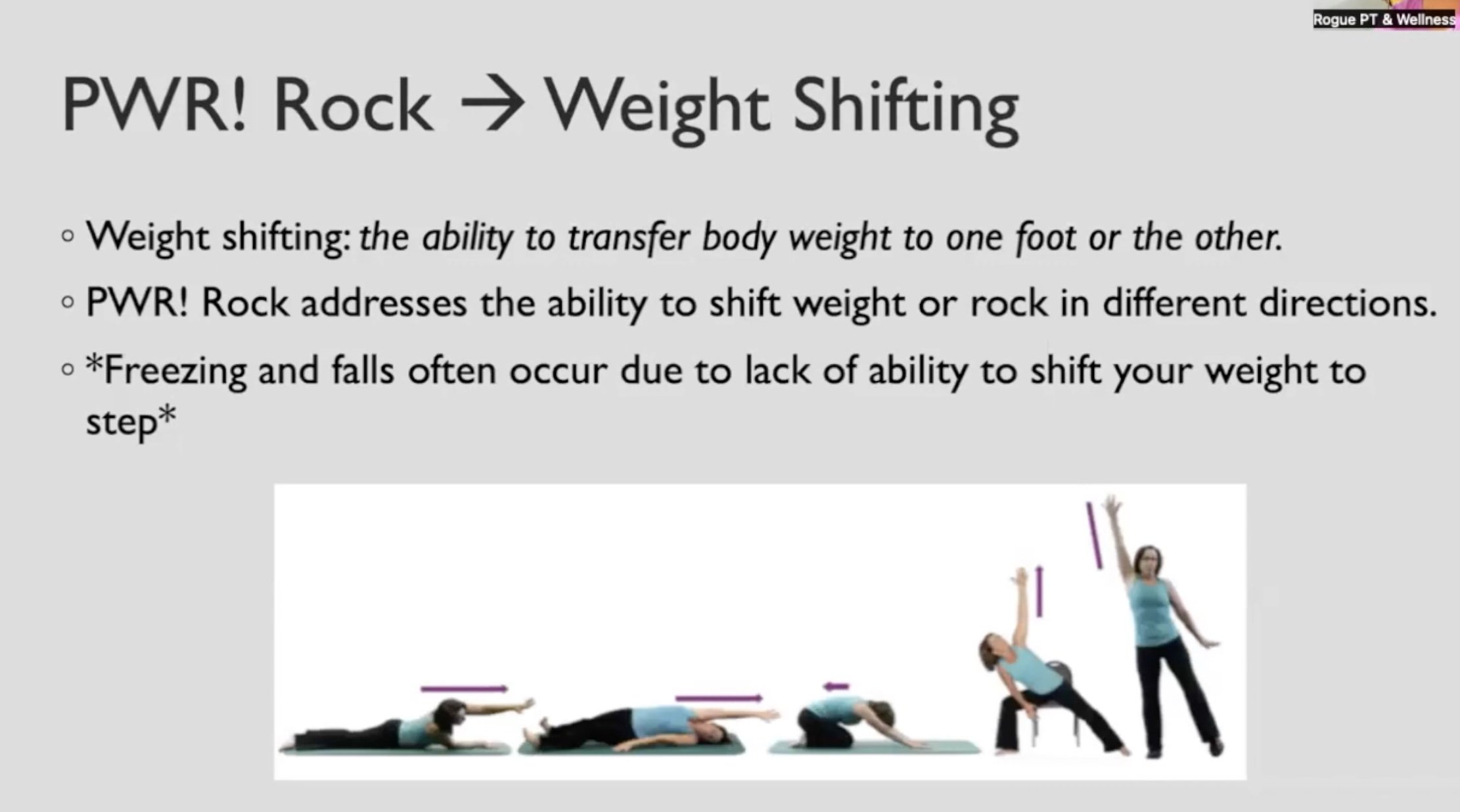
Purpose: Enhances balance and weight shifting.
How-To: Stand with feet shoulder-width apart. Gently shift your weight from one foot to the other, keeping movements smooth and controlled.

3. PWR! Twist

Purpose: Improves trunk rotation and flexibility
How-To: Sit in a chair with your feet flat on the ground. Place your hands on your knees, then twist your upper body to one side. Return to the center and repeat on the other side.

4. PWR! Step

Purpose: Encourages confident, deliberate steps
How-To: Step forward with your right foot, swinging your left arm forward at the same time. Alternate sides if you’re walking with purpose.

Can PWR! Moves Be Done Sitting?
Absolutely.
PWR! Moves are not limited to standing exercises.
The Basic 4 can be practiced in several positions, including:
Sitting
Standing
Supine, or lying on your back
Prone, or lying on your stomach
All four
The official PWR! program teaches the Basic 4 across these different positions so the exercises can be adapted and progressed based on the person and the activity being trained.
For someone who isn’t ready to perform a movement safely while standing, a seated variation may provide a more appropriate way to work on posture, weight shifting, rotation or stepping patterns.
Looking for seated PWR! Moves?
Why Exercise Matters With Parkinson’s
Regular exercise is an important part of living well with Parkinson’s.
Movement can help you work on areas that may become more challenging over time, including:
Strength
Mobility
Balance
Flexibility
Coordination
Endurance
Confidence with everyday movement
But Parkinson’s exercise is not simply about doing more activity.
How you move matters too.
That’s why Parkinson’s-specific approaches such as PWR! Moves focus on practicing movement strategies that relate directly to challenges people with Parkinson’s may experience.
Why Bigger Movements Matter
One common movement change in Parkinson’s is bradykinesia, or slowness of movement. Movements may also gradually become smaller than intended.
You may notice this in activities such as:
Taking shorter steps
Reduced arm swing
Difficulty getting out of a chair or bed
Smaller movements when turning
A more flexed posture
Difficulty initiating or transitioning between movements
Amplitude-based approaches encourage people to intentionally practice larger, higher-effort movements.
Both PWR! Moves and LSVT BIG incorporate large-amplitude movement, although they are structured and delivered differently.
PWR! Moves vs. LSVT BIG: What’s the Difference?
PWR! Moves and LSVT BIG are both Parkinson’s-specific approaches that incorporate larger-amplitude movement, but they are not the same program.
LSVT BIG
LSVT BIG is a standardized physical and occupational therapy treatment delivered by an LSVT BIG Certified Clinician.
The standard protocol consists of:
60-minute individual sessions
Four sessions per week
Four consecutive weeks
Daily homework and carryover practice
Although the treatment follows a standardized protocol, LSVT Global notes that it is tailored to each person’s individual goals and functional needs.
PWR! Moves
PWR!Moves is built around the Basic 4 movement patterns—Up, Rock, Twist and Step.
These principles can be practiced in multiple positions and incorporated into:
Individual rehabilitation
Group exercise
Home exercise
Recreation
Everyday activities
PWR! Moves can therefore be used as an exercise approach on its own or integrated into other movement and rehabilitation activities.
Which one is better?
It isn’t really a matter of one being universally “better.”
The right approach depends on your goals, abilities, access to trained professionals and whether you need individualized skilled therapy or an ongoing exercise program.
At Rogue Physical Therapy and Wellness, we incorporate PWR! Moves into our Parkinson’s-specific exercise programming because the approach works well across different exercise settings and can be adapted to the people we serve.
The Role of Community in Parkinson’s Wellness
One often overlooked aspect of Parkinson’s management is the power of connection. A supportive community can make all the difference in staying consistent with exercise, feeling motivated, and navigating the challenges of Parkinson’s.
Now, if you’re newly diagnosed or finding it hard to stay consistent with home routines, joining a local gym or Parkinson’s community could be a great step. You’ll meet individuals who share your journey and celebrate your victories. This sense of camaraderie turns exercise sessions into uplifting experiences that nourish both body and soul.
For those in the Orange County, California area, you can check out our in-person classes here at Rogue Physical Therapy and Wellness.
Online Parkinson’s Exercise Videos
If staying at home is your only option right now, you can still stay active and connect with others by signing up for live and recorded Parkinson’s-specific exercise sessions online. These tutorials provide step-by-step instructions led by physical therapists, ensuring you feel supported at every stage of your journey.
You can explore our interactive online classes at Rogue in Motion, designed to bring the same supportive and motivating environment straight to you, no matter where you are!
Stories of Transformation
Countless individuals with Parkinson's have experienced remarkable improvements in their symptoms and quality of life through amplitude training exercises.
In fact, one participant shared a powerful story of transformation after incorporating amplitude training into her daily routine. Not only did her physical abilities improve, but her confidence and communication skills flourished as well.
Here are the testimonials from people with PD:
“PWR! Moves allowed me to move around in bed and get off the floor safely!”
“PWR! Moves physically improved my everyday abilities such as the tightness that comes with PD. These classes are beneficial because they make us stronger and less likely to fall. Also, being in a class setting is such a positive experience where you receive support from the instructors and other members who have the same disease”.
“All the instructor’s education and awareness is at such a higher level than others and that allows us to participate in classes better”.
“The PWR! Moves help strengthen and lengthen muscles, improve my neurological patterning, and slow the rate of my Parkinson’s.”
These stories highlight the profound impact of programs like PWR! Moves can have, extending benefits far beyond physical improvements.
How to Get Started with PWR! Moves
The beauty of PWR! Moves lies in its simplicity and adaptability. Whether you prefer in-person classes, virtual sessions, or self-paced exercises, there’s an option to suit every lifestyle.
Tips for Success:
Start Small: Commit to just 15 minutes a day and gradually increase as you gain confidence.
Create a Routine: Dedicate a specific time each day to your exercises, building a consistent habit.
Celebrate Milestones: Recognize every bit of progress, no matter how small, as a step forward.
Final Thoughts
Parkinson’s may bring challenges but with tools like amplitude training and programs like PWR! Moves, those challenges can be met head-on. This isn’t just about managing symptoms but it’s about thriving, reclaiming independence, and living life on your terms.
So take the first step today. Whether you’re practicing from home or joining a class, every move you make is an investment in your well-being.
Remember: You are worth the effort, the time, and the care.
Start your PWR! Moves journey today, and discover just how transformative these exercises can be. Your future self will thank you.
If you want to learn more, click the video below to watch the lecture from Julia Freeman.